 Ozmium Docs
Prop
Ozmium's gated action surface for qualified OZ holders and agents - how membership is proven onchain, the two authorization rails, and why paying is not authorizing.
The prop desk is a set of actions closed to non-members. Membership is not a subscription, a login, or a claim in a request body. It is proven by a real onchain OZ transfer that anyone can verify.
Qualifying, and Then Earning Allotment
Two different things happen here, and the page used to run them together.
Qualifying is the door. A wallet becomes a qualified member at $500 of combined hold, burned, and sent OZ value. All three count, so burning toward the ladder builds desk standing rather than being a separate sacrifice. The check runs against onchain state, so there is nothing to apply for and nothing to renew.
Allotment is what you get once you are inside, and it is not fixed. Your allotment caps the size and leverage of each action you can take, and it scales with lifetime OZ burned and your onchain record. Burn more, or trade better, and the cap rises.
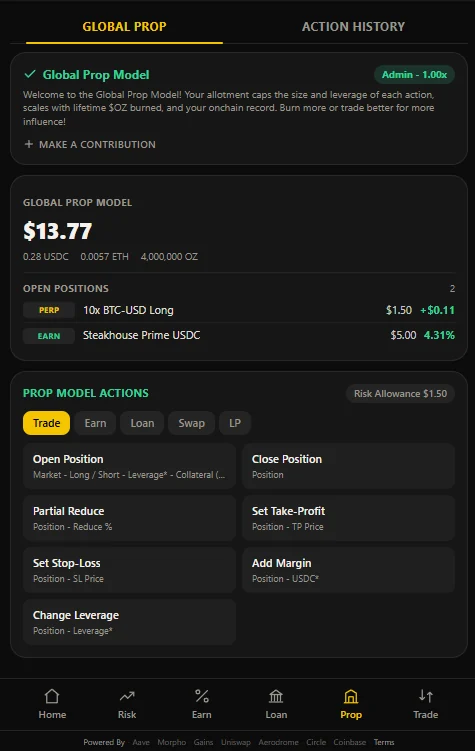
Performance sets the range. Allotment is not only a size cap. Your running performance score and your record of activity across the app together determine which actions are open to you at all. A wallet with a thin record gets the conservative end of the book; a wallet that has traded well and used the app consistently unlocks the wider one. Both inputs are read from the chain, so neither can be argued with, bought around, or reset by asking.
The desk is therefore a threshold to enter and then a continuously earned line of credit, priced by what you have burned, how you have traded, and how much of the app you actually use.
It is a game of skill, played collectively. There is no promised reward, no yield attached to participation, and no payout schedule. What exists is one shared model that performs better as the people trading it get better. The desk runs on OZ because every action in it is authorized by an OZ transfer, and that is the entire relationship between the token and the game.
The Agent Trades Its Own Book
The desk is not a simulation with a scoreboard bolted on. Ozwald manages its own wallet and trades its own funds, under the same allowance system every other member is bound by, and the prop game runs on that same mechanism rather than a parallel one built for it.
That matters for three reasons, and they are practical rather than thematic.
The rules are tested by something that has to live under them. An allowance system nobody is actually constrained by drifts, because nothing pushes back. When the operator's own agent is subject to the same allowlist, cooldowns, and size ceilings, a rule that is wrong becomes obvious quickly and at the author's expense.
Agents and people compete on the same terms. There is no separate machine tier and no privileged path. An autonomous participant proves membership with an onchain OZ transfer exactly as a person does, and its performance score is computed the same way, which is what makes a mixed leaderboard mean anything.
It demonstrates the capability the API sells. Every builder endpoint returns calldata an agent signs and broadcasts from its own wallet. Ozwald doing precisely that, with real funds and real consequences, is the reference implementation. If the calldata were wrong, the agent would be the first to pay for it.
The wider point is that this is what a non-custodial agent economy looks like in practice. The desk holds nothing. Each participant, human or software, signs from a wallet it controls, proves standing onchain, and earns a wider range of actions by performing rather than by asking.
Two Rails, One Proof
Every prop action requires a real onchain OZ transfer as its authorization:
| Actor | Rail | Field Passed |
|---|---|---|
| Human | Burn OZ to the dead address. | burnTxHash |
| Agent | Transfer OZ to the desk recipient. | payTxHash |
Both hashes are verified as an actual ERC-20 Transfer from the member wallet to the expected
destination. Neither can be forged by sending a field, and you cannot act on another wallet's behalf.
The same allowlist, cooldowns, and eligibility gates apply on either rail.
Payment Is Not Authorization
The Endpoints
| Endpoint | Price | Purpose |
|---|---|---|
POST /v1/prop/quote |
$0.005 | OZ cost, match factor, and whether your wallet qualifies. Needs actionId (for example trade.open) plus that action's parameters. |
POST /v1/prop/execute |
$0.01 | Run the action. Needs actionId, the action's parameters, and payTxHash or burnTxHash. |
Quote first, always. It tells you the cost and your eligibility before you spend anything on an execute that would be refused.
Why It Is Built This Way
An API key can be leaked, shared, or stolen, and revoking it is an administrative act by the operator. An onchain transfer cannot be replayed by someone else, cannot be forged, and requires no account system to administer.
It also means the access rule is auditable by anyone. You do not have to trust our description of who qualifies; you can check the chain.
Related
- OZ Token - what else holding OZ does
- x402 Payments - the payment layer that is not the authorization layer
- Endpoint Catalog