 Ozmium Docs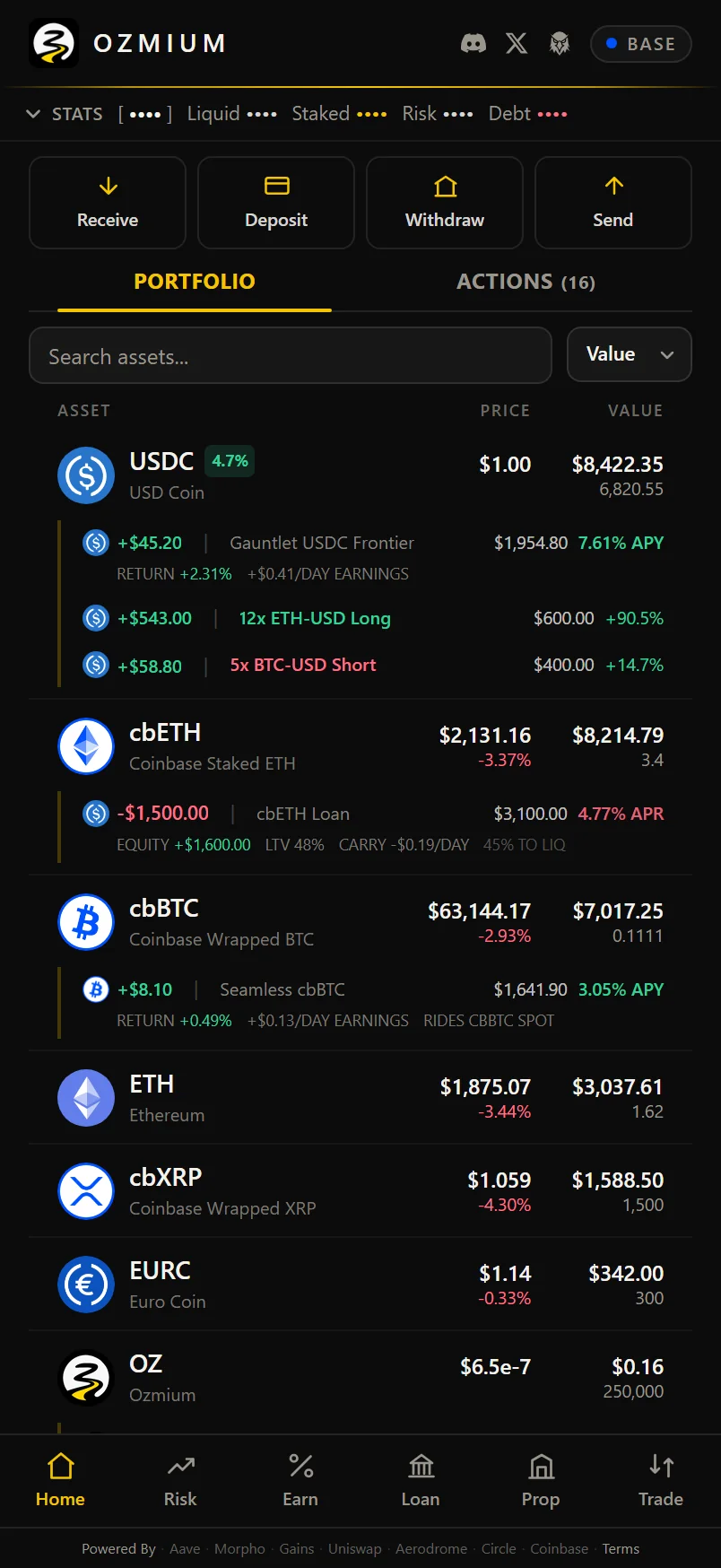
About Ozmium
What is Ozmium? A free, non-custodial AiFi and DeFi terminal on Base - trade, earn, borrow, and leverage from a wallet only you control.
Ozmium is an AiFi and DeFi terminal on Base mainnet, free and non-custodial. The same capabilities serve a person in the app and an autonomous agent over the agent API, which is what the Ai in AiFi means here. It is an interface, not a protocol: it reads public onchain state, assembles transactions, and hands them to your wallet to sign.
That distinction is the entire product. There is no Ozmium account, no balance held on your behalf, and no withdrawal to request. Your assets stay in your wallet from the moment you arrive until the moment you leave, and the only thing that ever moves them is a transaction you signed. The collapses that defined the last cycle - Celsius, FTX, BlockFi - were custodial failures: users had sent their assets to a company and were left filing claims against its estate. That failure mode does not exist here, because there is nothing to send.
Which is what self-custody was supposed to mean. Software you can use without trusting whoever operates it, and walk away from without asking permission.
What You Can Do with It
Four things, on four screens, built to compose. An asset held in a wallet does nothing. Supplied to a vault, it earns. Pledged as collateral, it borrows - and that is the step most people skip. Borrowing against a position raises cash without selling it, so you keep the asset and whatever it does next, rather than closing the position to fund something else. The stablecoins that come out can margin a hedge, buy more of what you actually wanted, or sit idle earning yield until you need them. Hold, earn, borrow against, redeploy: the ordinary mechanics of balance-sheet leverage, running without an underwriter, a credit committee, or a counterparty who can call the loan.
| Action | Venue | What the Screen Gives You |
|---|---|---|
| Trade | Coinbase CDP Trade API, Permit2 | Spot swaps across the Base pair universe. Expected output, route, price impact, minimum received, maximum slippage, and protocol fee are itemized before you sign |
| Earn | Morpho ERC-4626 vaults, Aave v3, Aerodrome, Uniswap v3 | A vault list carrying live net APY, TVL, and a 52-week APY range, with the vault contract address shown. Supply and withdraw are each one action. Providing liquidity to the OZ pools lives here too, and accrued swap fees can be collected without withdrawing the position |
| Borrow | Morpho Blue, Morpho Midnight | Floating-rate collateralized loans against a visible LLTV ceiling, or fixed-rate fixed-term borrowing with a stated maturity. A risk panel reads the live position and reports how far the market must move to liquidate it |
| Leverage | Gains Network gTrade | Long or short perpetuals on USDC collateral, up to 200x, across six asset classes: crypto, forex, metals, energy, indices, and equities. Take-profit, stop-loss, and leverage are adjustable without closing |
Design Principles
One surface, many protocols. Yield, borrowing, perpetuals, and swaps normally live in separate apps with separate mental models. Ozmium puts them behind one portfolio view, so the question "what should I do with this position" has one place to be answered.
Sized against what the market has actually done. Rather than offering you a leverage slider and wishing you luck, the tooling reads the market's recent realized volatility and works backward to a size that survives it. You see the liquidation price before you sign, not after, and you see how far the market would have to move to reach it.
Valuations are confidence-gated. Where a price feed or RPC call fails, the interface retains the last known-good value and marks it as stale instead of substituting zero. Unavailable data is displayed as unavailable.
AI agents are first-class. Every capability in the app is also an HTTP endpoint an autonomous agent can pay for per call. See For AI Agents.
Why This One
Anyone can generate an interface now. What does not fall out of a prompt is the part that has to be correct: an encoding against a live contract, a number that stays honest when the feed behind it fails, a stranded order somebody can actually recover. Those come from operating the thing, and Ozmium's differences are all in that category.
One surface across protocols that do not agree with each other. Morpho, Aave, Gains, Aerodrome, and Uniswap each scale parameters differently, use different decimals, and mean different things by the same word. Reconciling them into one portfolio view and one set of correctly encoded transactions is the work, and it does not generalize from a template.
The same terminal for people and for AI agents. Every capability in the app is an HTTP endpoint an agent pays for per call, priced from a tenth of a cent, with no account, no key, and no SDK. Payment is the credential. Most products bolt an API onto a UI; here they are the same surface, which is what AiFi means when it is not a slogan.
Failure states that tell the truth. A dead price feed holds its last known-good value and marks it stale rather than printing a confident zero. An agent's factual claim is blocked unless a tool call backs it. A market order the venue never filled is surfaced and recoverable, never silently absorbed. Each of those is a decision made after watching the alternative hurt someone.
Built where the industry does not build. The operation runs from rural America, in service of small independent builders, not institutional flow, and the aim is to put this infrastructure somewhere physical instead of only onchain. That constrains what gets built: tools people can afford to use, priced for a person putting in a hundred dollars rather than a fund putting in a million.
Built for Its Own Operator
Ozmium is used daily by the person who builds it, and the specialization shows. The reason every technical read and the news that moves it sit on one screen, and the reason lending, staking, swaps, and leverage all resolve in one place, not across five tabs, is that this is the tool its author wanted and could not find.
That is worth stating outright instead of dressing it up as market research. Software built for a real user with a real position tends to be honest about the parts that hurt, because the author is the first person the dishonest version would cost.
Custody
"Non-custodial" gets used loosely enough that it is worth spelling out mechanically. So what does it actually mean here?
- Ozmium operates no contract that holds user funds.
- Every write action resolves to a standard Base transaction
{ to, data, value }. - Your wallet shows you that transaction, and you approve it or you do not.
- If Ozmium disappeared tomorrow, every position you hold is still yours and still manageable directly at Morpho, Aave, Gains, Aerodrome, or Uniswap.
FAQ
Is Ozmium custodial?
No. Ozmium operates no contract that holds user funds and never signs on your behalf. Every action is a standard Base transaction your own wallet approves, and every position remains manageable directly at the underlying protocol if Ozmium disappeared.
What protocols does Ozmium use?
Gains Network gTrade for leveraged perpetuals with USDC collateral, Morpho and Aave v3 for lending vaults and collateralized borrowing, Uniswap v3 and Aerodrome for the OZ liquidity pools, and the Coinbase Developer Platform for swap routing and on-ramps.
Why is Ozmium only on Base?
Base is an Ethereum layer-2 built and incubated by Coinbase, secured by Ethereum, and operated as public infrastructure with a stated commitment to open-source development and progressive decentralization. Building on Ethereum means inheriting the most battle-tested settlement layer in the industry; building on Base means inheriting that security at fees low enough that modest positions and active management are economically sensible.
Deploying to a single network is also a correctness decision. One chain means one verifiable contract address set, one gas model, and no bridge dependency introduced by this interface. Bridges have historically been the largest single category of loss in this sector, and Ozmium does not operate or route through one.
Can I use Ozmium without a wallet?
You can browse it without one. Public data - vault lists with live APY, the tradeable pair universe, charts, and loan markets - renders clean and fully usable in preview mode. Wallet-keyed views are covered with frosted glass over clearly labeled demo samples, and nothing throws a connect popup at you. Transacting is what needs a wallet.
Does Ozmium charge fees?
Not to humans. The app is free, and Ozmium takes no cut of swaps. You still pay network gas, the underlying venue's own fees, and price impact. Automated clients pay per call for the agent API.
Does Ozmium send me tax forms or account statements?
No. Ozmium is not a broker, issues no statements or forms, and reports nothing to any tax authority on your behalf. Your records are the chain itself: every transaction under your address is permanently readable on free block explorers such as Basescan, which will export a complete history. Whether a given trade, yield payment, or liquidation creates a taxable gain or a deductible loss depends on your jurisdiction and your situation, and that is a question for a qualified professional. See Terms And Risk.
Is Ozmium a bank or a broker?
No. Ozmium is not a bank, broker, dealer, exchange, adviser, or your counterparty, and it does not solicit or recommend transactions. It is software that builds transactions you choose to sign.
Where to Go Next
- The whole thesis in one document: Litepaper
- New to all of this: Quickstart
- The Ozmium agent: Ozwald
- Need a wallet or a Base account: Wallets And Base
- Unfamiliar terms: Glossary
- Building an agent: For AI Agents